Research Assistant, Robotics and State Estimation Lab, University of Washington
I’m Yuzhi Fan, a Computer Science graduate from the University of Washington. I am currently a Research Assistant advised by Prof. Dieter Fox in the Robotics and State Estimation Lab, where my research aims to enable robots to predict and reason about the consequences of their own actions in the world.
World-action models (WAMs) predict the future to act better, but they mainly predict RGB latents trained for pixel reconstruction — with no explicit signal for the 3D geometry or object semantics that manipulation needs. We introduce Flex-π, a 6B-parameter WAM that jointly denoises RGB, 3D geometry, and object-centric DINO semantics with actions in a shared latent space. Per-stream dropout with cross-modality forcing yields a single checkpoint that runs on any subset of streams — from fast action-only inference to full joint generation — with no new sensors or visual priors. The result is a demonstration-efficient policy that beats the strongest baselines by up to 2–6× on dexterous, precise, real-world bimanual tasks in and out of distribution — while running faster than π0.5.
@article{yan2026flexpi,title={Flex-π: A Multi-Stream World-Action Model with Compute Flexibility},author={Yan, Ge and Liu, Jinghao and Fan, Yuzhi and Cai, Lei and Liao, Minwen and Zhang, Jesse and Fox, Dieter},journal={arXiv preprint arXiv:2608.10860},year={2026},}
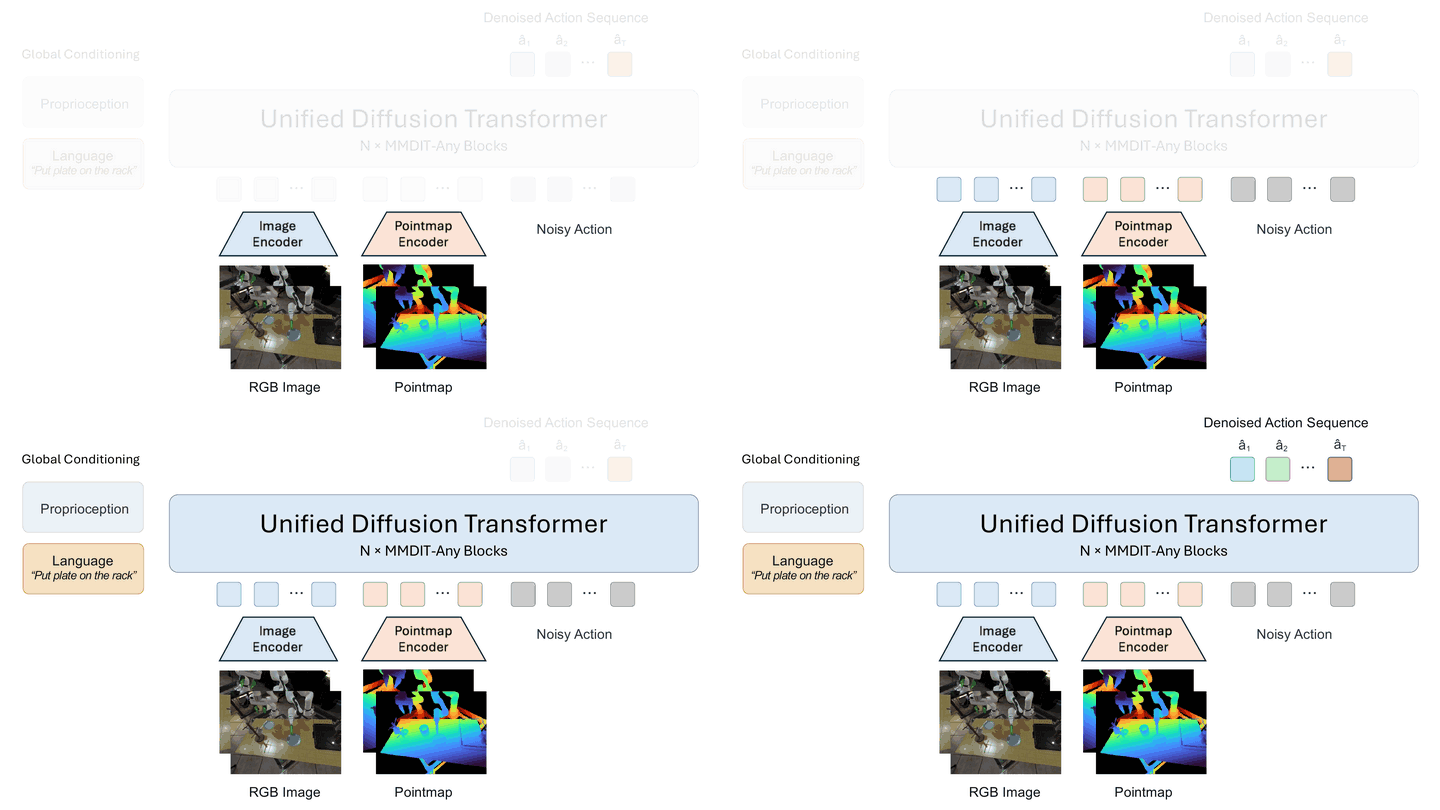
Visuomotor manipulation policies face a persistent trade-off: image-only policies inherit the semantic priors of large-scale 2D pretraining but are brittle to lighting, texture, and viewpoint shift, whereas 3D-only policies are robust to such factors yet are often trained from scratch. Some recent multi-modal policies combine both streams but typically process 3D through a from-scratch encoder, preserving this asymmetry. We present UniFlow, a unified 2D+3D co-training recipe for manipulation in which 3D observations are represented as image-shaped pointmaps so that pretrained 2D backbones can be used to encode both modalities, and RGB and pointmap streams are fused by a unified diffusion transformer with per-modality modulation. On average across thirteen dexterous manipulation tasks from the challenging LBM simulation benchmark, UniFlow outperforms a strong RGB-only baseline in a distribution-shifted setting. UniFlow also outperforms the generalist VLA when averaged over five RoboTwin bimanual tasks as well as four real-world YAM tasks.